

So you think your car battery is good, huh? Well, before you hit the road and end up stranded, it's time to put it to the test.
In this article, we'll show you some simple tests and indicators to determine if your battery is actually bad. From a visual inspection to voltage and load testing, we've got you covered.
Don't let a faulty battery hold you back – learn how to liberate yourself from uncertainty and keep your car running smoothly.
Key Takeaways
- Visual inspection is important to check for battery corrosion, physical damage, and loose connections.
- Voltage testing using a digital multimeter can help determine the battery's charge level.
- Load testing with a load tester can assess the battery's functionality.
- Electrolyte testing through specific gravity measurement and voltage readings can indicate the battery's condition.
Visual Inspection
You can easily determine if a car battery is good or bad through a visual inspection. Start by checking for any signs of battery corrosion. Look for a white, powdery substance around the battery terminals. This corrosion can hinder the flow of electricity and affect the overall performance of the battery. If you notice any corrosion, it's important to clean it off using a mixture of baking soda and water.
Next, examine the battery for any physical damage. Look for any cracks, leaks, or bulges on the battery casing. These can be indicators of a damaged battery that may need to be replaced. Additionally, check the battery terminals for any signs of damage or loose connections.
During your visual inspection, make sure to also check the battery's age. Most car batteries have a date code stamped on them, indicating when they were manufactured. If the battery is older than three to five years, it may be nearing the end of its lifespan and should be tested further.
Voltage Testing
To determine the condition of your car battery, start by conducting a voltage test. This is a simple yet effective way to assess the health of your battery.
To begin, you'll need a digital multimeter. Set the multimeter to DC voltage and ensure it's in the appropriate range for automotive batteries, typically between 12 and 14 volts.
Next, turn off all electrical components in your car, including lights, radio, and air conditioning.
Take the multimeter's positive (red) probe and connect it to the positive terminal of the battery. Then, connect the negative (black) probe to the negative terminal. The multimeter will display the battery's voltage.
A fully charged battery should read around 12.6 to 12.8 volts. If the voltage is significantly lower, it indicates that the battery may be discharged. On the other hand, if the voltage is higher than 12.8 volts, it suggests that the battery is overcharged.
Regular voltage testing is essential for battery maintenance and can help you identify any potential issues before they become major problems. By keeping a close eye on your battery's voltage, you can ensure its optimal performance and prolong its lifespan.
Recommended Products

Accurately Test Full Features: Accurately measures AC/DC voltage, DC current, resistance, continuity test, diode and batteries.
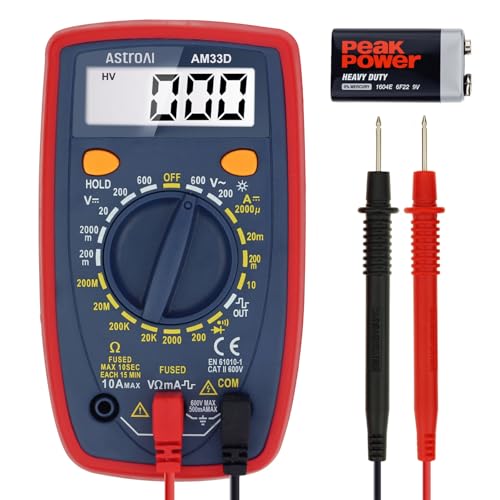
Additional Tips - The following incorrect operations may cause the multimeter not to show results: Firstly, the plugs of test leads are not fully inserted or not inserted into the correct sockets. Secondly, the manual rotary switch is not placed in the correct position. In addition, this meter can not test all AC Current and below 100mV AC Voltage. Please check the user manual carefully before measurement.

Versatility: ANENG multi meter is a highly adaptable electronic tool that can be used to measure a wide range of electrical properties, including AC/DC voltage, current, resistance,continuity,diode and Live wire.This makes it an essential tool for anyone working with electronics or electrical systems,also widely used by hobbyists, students, and professionals in various fields, including engineering, automotive repair, and electricians.
Load Testing
Performing a load test is a reliable way to determine the condition of your car battery and ensure its optimal functionality. It involves applying a load to the battery and measuring how well it can sustain that load. This test is especially important because it evaluates the battery's load capacity, which directly affects its ability to start your vehicle and power its electrical components.
To perform a load test, you will need a load tester, which can be easily found at an automotive supply store. Follow these steps:
- Start by fully charging your car battery. This ensures accurate results.
- Connect the load tester to the battery terminals, following the manufacturer's instructions.
- Apply a load equal to or slightly higher than the battery's Cold Cranking Amps (CCA) rating.
- Observe the voltage reading on the load tester. If it drops significantly and quickly, it indicates a weak or faulty battery.
By conducting a load test, you can assess your battery's health and make an informed decision about its replacement. To help you understand the results, refer to the table below:
| Voltage Reading | Battery Health |
|---|---|
| 12.6V or above | Good |
| 12.4V – 12.6V | Fair |
| 12.2V – 12.4V | Weak |
| Below 12.2V | Replace ASAP |
Recommended Products

[Car Battery Tester] You can easily test and inspect your 12V lead-acid battery with this TOPDON car battery tester. The SOH (State of Health), SOC (State of Charge), Voltage, Current, Rating, and numerous other understandable analytical data are provided by this battery tester. It is compatible with 100-2000CCA regular flooded, AGM flat plate/spiral, EFB, and GEL for their optimum performance.

Catch Battery Problems Early: Featured in two videos by Project Farm, a popular YouTube channel with millions of subscribers, the ANCEL BA101 helps you quickly spot battery issues before they leave you stranded. It provides easy-to-understand readings for State of Health (SOH), State of Charge (SOC), voltage, current, CCA, plus cranking and charging system tests, so you can better understand your battery and help avoid unexpected breakdowns

Universal Battery Tester 12V / 24V: TopDiag BT300 battery load tester is able to detect the faults of car starting system and charging system, perform quick test and standard test, can test all automotive starter batteries, such as ordinary lead-acid batteries, AGM flat batteries. AGM spiral batteries and gel batteries. BT300 car battery checker can test most of the current battery standards, include: CCA, JIS, GB, SAE, MCA, CA, DIN, IEC, EN, BCI, etc. Notice: It's not compatible with 6V batteries and is not suitable for use with lithium batteries.
Electrolyte Testing
To determine if your car battery is good or bad, check the electrolyte using a hydrometer or a voltmeter. The electrolyte level and specific gravity are important indicators of the battery's health. Here's how you can test the electrolyte:
- Check the electrolyte level: Open the battery caps and inspect the electrolyte level. It should be above the plates, but not overflowing.
- Use a hydrometer: This device measures the specific gravity of the electrolyte. Insert the hydrometer into each cell and draw some electrolyte into it. Read the specific gravity value on the hydrometer's scale. A specific gravity reading below 1.225 indicates a weak battery.
- Use a voltmeter: Set your voltmeter to DC voltage and connect the positive lead to the battery's positive terminal and the negative lead to the negative terminal. A fully charged battery should read around 12.6 volts. Anything below 12.4 volts indicates a weak battery.
- Interpret the results: If the electrolyte level is low or the specific gravity/voltage readings are low, it's a sign that the battery isn't in good condition and may need to be replaced.
Cold Cranking Amps (CCA) Testing
By checking the cold cranking amps (CCA) and conducting a load test, you can determine if your car battery is in good condition. The CCA measurement is a crucial factor in evaluating battery performance. CCA refers to the number of amps a battery can deliver at 0 degrees Fahrenheit for 30 seconds while maintaining a voltage of at least 7.2 volts. A higher CCA rating indicates a stronger and more reliable battery.
To perform a CCA test, you'll need a CCA tester or a multimeter capable of measuring high currents. Connect the positive (red) probe to the positive terminal of the battery and the negative (black) probe to the negative terminal. Set the tester to the CCA range and follow the manufacturer's instructions to obtain an accurate reading.
Typically, an average car battery should have a CCA rating that meets or exceeds the manufacturer's specifications for your vehicle. If the CCA measurement falls below the recommended value, it indicates a weakened battery that may struggle to start your car in cold weather conditions.
Recommended Products

🔥【A MUST HAVE TOOL IN YOUR GARAGE】 - With up-to-date testing technology, it provides a quick reading to determine whether a vehicle battery needs a jump or replacement and also the output status of the alternator. All you have to do is log in and play. Save your time and money.

【3-IN-1 Car Battery, Starter & Alternator Tester】The ANCEL BST100 car battery tester checks battery health, engine cranking performance, and alternator charging output to help identify whether slow starts, repeated battery drain, or charging concerns may come from the battery, starter, or charging system. A practical automotive battery tester for faster troubleshooting before replacing parts

Professional Battery Diagnostic: BT500 car battery tester is all-in-one diagnostic solution, engineered for wide compatibility. It accurately tests 6V, 12V, 24V battery, supporting regular flooded, AGM flat plate, AGM spiral, GEL and EFB battery. Whether you're checking a car before a long commute, or a truck battery on job site, this battery load tester provides reliable data on voltage, resistance, State of Health (SOH) and State of Charge (SOC). Not available for lithium battery、deep-cycle battery、golf cart
Frequently Asked Questions
How Long Does a Car Battery Typically Last Before It Needs to Be Replaced?
Typically, a car battery lasts around three to five years before needing replacement. However, several factors such as car battery maintenance, usage patterns, and signs of a dying car battery can affect its lifespan.
Can a Car Battery Be Recharged if It Is Determined to Be Bad?
If your car battery is determined to be bad, you can try car battery reconditioning to recharge it. This process can help prolong the life of your battery and potentially save you money.
Are There Any Warning Signs or Symptoms That Indicate a Car Battery Is About to Fail?
Are there any signs or symptoms warning that your car battery is about to fail? Learn how to test car battery health and be prepared for unexpected breakdowns. Don't let a dead battery ruin your day.
How Can Extreme Weather Conditions Affect the Performance and Lifespan of a Car Battery?
Extreme weather conditions, such as extreme temperatures and high humidity, can greatly impact the performance and lifespan of your car battery. These conditions can cause the battery to lose charge faster and can even lead to internal damage.
Can a Car Battery Die Suddenly Without Any Prior Warning Signs?
Car battery sudden failure can happen without warning signs. Factors like age, extreme weather, and poor maintenance contribute to this. Regularly test your battery to avoid being stranded.

Evan Armstrong is a lead automotive engineer at Car Troubleshooters with over 15 years of experience in the automotive industry. He has a Master's degree in Automotive Engineering and a deep understanding of how cars work and what it takes to fix them.